
Gut Microbiota Medium (GMM)
- Product Code: GMNB-GMM01
- Availability: In Stock
Tags: Gut Microbiota Medium
Overview
The defining ingredient is porcine gastric mucin (Sigma Type II or Type III, 4 g/L) — a complex glycoprotein that no other commercial culture medium currently supplies. The mucin provides both a fermentable substrate for mucin-degrading organisms (A. muciniphila, Bacteroides thetaiotaomicron mucin-utilisation locus, Ruminococcus torques, R. gnavus reclassified Mediterraneibacter gnavus) and host-glycan signal that primes expression of polysaccharide-utilisation loci. The medium also includes SCFA (acetate 33 mM, propionate 9 mM, isobutyrate / isovalerate / valerate 1 mM each — added post-autoclave inside the AAE), which support cross-feeding of SCFA-utilising Firmicutes. Because no commercially-validated ready-to-rehydrate GMM exists, this product addresses a clear market gap and complements the GMExpression YCFA platform for full-coverage human gut culturomics.
We also have
YCFA Modified Medium · YCFA Full Recipe · YCFA Base · Modified Chopped Meat Broth (ATCC 1490) · Chopped Meat with Carbohydrates · Beef Granules
Package Contents
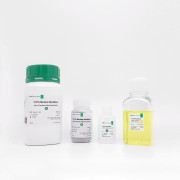
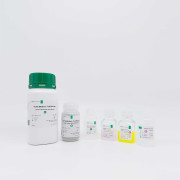
Each GMExpression GMM kit contains:
- Mixture A — pre-weighed GMM base (BHI base 18 g/L + yeast extract 5 g/L + Trypticase 5 g/L + glucose 2 g/L + cellobiose 1 g/L + maltose 1 g/L + soluble starch 1 g/L + K2HPO4 + KH2PO4 + NaCl + MgSO4 + CaCl2 + resazurin) for 5 L final volume.
- Mixture B — porcine gastric mucin (Sigma Type II / III) 20 g + L-cysteine·HCl 2.5 g, pre-blended, N2-flushed PP bag.
- Stock H — Hemin stock, 25 mg in 5 mL of 0.05 M NaOH.
- Stock K — Vitamin K1 stock, 50 mg in 5 mL of 95 % ethanol, amber.
- Stock S — SCFA mixture — concentrated stock of acetate, propionate, iso-butyrate, iso-valerate, valerate in oxygen-free water, glass ampoule, N2-flushed. For post-autoclave addition inside the AAE.
- 5 × airtight PP storage bags + 5 × heat-resistant rubber bands.
- Instruction manual (A5 booklet, v1.0) with explicit Goodman-2011 protocol annex.
Customisation options on request: agar variant at 15 g/L for plates; HMO-supplemented variant for infant-gut culturomics; defined-medium variant with bovine submaxillary mucin (Sigma M3895) for vegan / non-porcine pharma applications; supply as PRAS Hungate tubes pre-poured ready for direct inoculation.
Composition — per 1 L equivalent unless stated otherwise
GMM Broth (Goodman 2011 PNAS reference; per 1 L)
| Component | Concentration | Function |
|---|---|---|
| Brain Heart Infusion base (dehydrated) | 18.0 g | Rich peptone, glucose, infusion solids base |
| Yeast extract | 5.0 g | B-vitamins, NAD precursors |
| Trypticase (pancreatic digest of casein) | 5.0 g | Supplementary peptide source |
| D-Glucose | 2.0 g | Primary carbohydrate |
| Cellobiose | 1.0 g | Disaccharide; supports Ruminococcus, Bacteroides |
| Maltose | 1.0 g | Disaccharide; supports glucose-derived utilisation |
| Soluble starch | 1.0 g | Polysaccharide; supports starch-utilising organisms |
| Porcine gastric mucin (Sigma Type II / III) | 4.0 g | Critical differentiator — supports Akkermansia muciniphila and mucin-degrading commensals; primes polysaccharide-utilisation locus expression |
| L-Cysteine·HCl·H2O | 0.5 g | Reductant; Eh < −150 mV |
| Hemin (CAS 16009-13-5) | 5.0 mg | Required by Bacteroides |
| Vitamin K1 (CAS 84-80-0) | 1.0 mg | Menaquinone precursor |
| K2HPO4 / KH2PO4 | 2.0 g / 1.0 g | Phosphate buffer |
| NaCl, MgSO4, CaCl2 | 2.0 g / 0.2 g / 0.05 g | Mineral mix |
| Resazurin | 1.0 mg | Redox indicator (pink/red oxidised, colourless reduced) |
SCFA mix (Stock S; post-autoclave addition inside AAE; final concentrations in medium)
| Short-chain fatty acid | Final concentration | Notes |
|---|---|---|
| Sodium acetate | 33 mM (2.7 g/L equiv) | Major SCFA; energy source for acetate-utilising Firmicutes |
| Sodium propionate | 9 mM (0.86 g/L equiv) | Secondary SCFA; Bacteroides/Akkermansia end-product |
| Iso-butyric acid | 1 mM (0.09 g/L equiv) | Branched-chain SCFA from leucine/valine catabolism |
| Iso-valeric acid | 1 mM (0.10 g/L equiv) | Branched-chain SCFA |
| Valeric acid (n-valeric) | 1 mM (0.10 g/L equiv) | Cross-feeding precursor for valerate-utilising Firmicutes |
Pre-autoclaving pH: 7.2 ± 0.2 at 25 °C. Post-SCFA addition target pH: 6.8–7.0 (SCFAs lower pH; verify and adjust if needed).
Use and Applications
- Maximum-diversity culturomics of the human gut microbiota per Goodman et al. (2011) protocol. The benchmark medium for studies aiming to recover the broadest cultivable fraction of human stool / colonic mucosa.
- Targeted enrichment of Akkermansia muciniphila ATCC BAA-835 / DSM 22959 for live-biotherapeutic-product manufacturing (Plovier et al. 2017 Nat Med 23:107; A2-Akkermansia is a clinical-development asset).
- Mucin-degradation phenotyping of new isolates and gut commensals — colonies on GMM agar can be tested for mucin-clearing zones (mucinolysis assay).
- Cross-feeding studies of SCFA-utilising butyrate producers (Faecalibacterium, Roseburia, Anaerobutyricum hallii) growing on acetate and propionate cross-fed from primary fermenters.
- Polysaccharide-utilisation locus (PUL) induction studies in Bacteroides thetaiotaomicron and related glycan-utilisers, where the porcine gastric mucin serves as the inducer signal.
- Cultivation-validated isolation of gut commensals from murine stool in gnotobiotic colonisation studies — Goodman et al. 2011 used GMM to construct defined community models for gnotobiotic mouse work.
- Stool-bank QC for fecal microbiota transplantation (FMT) consortium-validation workflows.
Compatible Microorganisms
Mucin-degraders (the GMM signature group)
- Akkermansia muciniphila (ATCC BAA-835 = DSM 22959) — verrucomicrobial flagship organism; intestinal-mucin specialist; not recoverable on standard BHI/YCFA
- Bacteroides thetaiotaomicron (ATCC 29148) — extensive mucin-utilisation locus repertoire
- Mediterraneibacter gnavus (formerly Ruminococcus gnavus; reclassified Togo et al. 2018 / Lawson et al. 2023)
- Ruminococcus torques — mucin-degrading commensal
- Bifidobacterium bifidum — extracellular endo-β-galactosidases acting on mucin glycans
SCFA-utilising butyrate producers (cross-feeding on the SCFA mix)
- Faecalibacterium prausnitzii (DSM 17677) — acetate utilisation for butyrate production
- Roseburia intestinalis (DSM 14610)
- Agathobacter rectalis (formerly Eubacterium rectale; reclassified Rosero et al. 2016)
- Anaerobutyricum hallii (formerly Eubacterium hallii; reclassified Shetty et al. 2018)
- Anaerostipes caccae, A. hadrus
General gut commensals
- Bacteroides fragilis, B. vulgatus, B. uniformis, B. ovatus, B. caccae
- Parabacteroides spp.
- Bifidobacterium spp. (TPY preferred for selective Bifidobacterium isolation)
- Lactobacillus sensu lato (per Zheng et al. 2020 reclassification)
- Eubacterium limosum
- Christensenella minuta (DSM 22607)
- Coprococcus catus, C. eutactus
Preparation
Critical control points
- Mucin source and grade. Use Sigma Type II (M2378, partially purified) or Type III (M1778, more highly purified). Other mucin sources (bovine submaxillary, ovine intestinal) work but give different growth kinetics for A. muciniphila specifically. Document the mucin source in the QA file.
- SCFA addition order. SCFAs must be added after autoclaving (they would partially evaporate and degrade at 121 °C). Add inside the AAE after the medium is reduced and cooled to ≤ 50 °C. Final pH check is mandatory.
- Resazurin reduction verification. Before inoculation, the medium must be visually colourless (pink-red = oxidised, will not support A. muciniphila or other strict anaerobes). 24-h pre-reduction inside the AAE is standard.
Cautions
Storage and Expiry · Safety
- Dehydrated Mixture A: 15–30 °C in original packaging. Shelf life 30 months.
- Mixture B (mucin + cysteine, N2-flushed): 4 °C in original sealed packaging. Shelf life 12 months sealed; use within 14 days of opening (mucin is hygroscopic and cysteine oxidises).
- Stock H, Stock K: as for BHI-S — 4 °C, light-protected; 8 weeks (hemin), 6 months (VK1).
- Stock S (SCFA, glass ampoule, N2-flushed): 4 °C. Sealed shelf life 12 months; use opened ampoule within 24 h.
- Prepared broth, aerobic 4 °C: 2 weeks routine (mucin is a perishable substrate).
- Prepared broth, anaerobic (vacuum-sealed + O2 absorber): 8 weeks for strict-anaerobe use.
Safety notes. Porcine and bovine biological components. Mucin in dust form is a respiratory irritant — handle Mixture B inside a laminar-flow hood or fume hood. SCFAs are odorous; perform Stock S addition under controlled ventilation. SDS available on request.
References
- Goodman AL, Kallstrom G, Faith JJ, Reyes A, Moore A, Dantas G, Gordon JI. (2011). Extensive personal human gut microbiota culture collections characterized and manipulated in gnotobiotic mice. PNAS 108(15): 6252–6257. doi: 10.1073/pnas.1102938108. [Primary reference for GMM]
- Plovier H et al. (2017). A purified membrane protein from Akkermansia muciniphila or the pasteurized bacterium improves metabolism in obese and diabetic mice. Nature Medicine 23(1): 107–113.
- Derrien M, Vaughan EE, Plugge CM, de Vos WM. (2004). Akkermansia muciniphila gen. nov., sp. nov., a human intestinal mucin-degrading bacterium. IJSEM 54: 1469–1476.
- Browne HP et al. (2016). Culturing of 'unculturable' human microbiota reveals novel taxa and extensive sporulation. Nature 533: 543–546.
- Lagier J-C et al. (2016). Culture of previously uncultured members of the human gut microbiota by culturomics. Nature Microbiology 1: 16203.
- Rosero JA et al. (2016). Reclassification of Eubacterium rectale in the genus Agathobacter. IJSEM 66: 768–773.
- Shetty SA, Zuffa S, Bui TPN, Aalvink S, Smidt H, de Vos WM. (2018). Reclassification of Eubacterium hallii as Anaerobutyricum hallii. IJSEM 68: 3741–3746.
- Sigma-Aldrich product specifications: Mucin from porcine stomach Type II (M2378) and Type III (M1778).