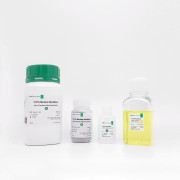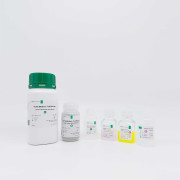



Egg Yolk Agar (McClung-Toabe) | For 5L
- Product Code: GMNB-EYA01
- Availability: In Stock
Overview
The differential mechanism reads two distinct phospholipid-hydrolysing enzymes against a single substrate: egg yolk. Lecithinase (phospholipase C; the C. perfringens α-toxin) hydrolyses lecithin (phosphatidylcholine) to insoluble diglyceride and phosphocholine — visible as an opacity halo extending several mm beyond the colony into the egg-yolk-supplemented agar. Lipase (triglyceride esterase; characteristic of C. botulinum and C. sporogenes) hydrolyses triglycerides to free fatty acids — visible as a pearly iridescent layer on the colony surface (free fatty acids form a lipid film). C. perfringens shows both a lecithinase opacity halo AND (when blood is added) a double-zone β-haemolysis (inner θ-toxin / perfringolysin O zone + outer α-toxin lecithinase zone) — the combined picture is essentially pathognomonic.
The Nagler half-plate test (using C. perfringens type A α-toxin antitoxin spread on half a plate) is the confirmatory identification step: C. perfringens lecithinase is suppressed on the antitoxin half (no halo), while C. bifermentans, C. sordellii, and C. novyi lecithinases are not antitoxin-suppressible. For selective application, add neomycin 100 mg/L (post-autoclave filter-sterilised) to make EYA-Neo, which suppresses facultative aerobes and supports Clostridium-specific phenotyping.
We also have
YCFA Modified Medium · YCFA Full Recipe · YCFA Base · Modified Chopped Meat Broth (ATCC 1490) · Chopped Meat with Carbohydrates · Beef Granules
Package Contents
Each GMExpression Egg Yolk Agar Complete Kit contains:
- Base agar (dehydrated) — pre-weighed McClung-Toabe base (proteose peptone 40 g/L + Na2HPO4 5 g/L + KH2PO4 1 g/L + NaCl 2 g/L + MgSO4·7H2O 0.1 g/L + glucose 2 g/L + agar 20 g/L) for 1 L final volume.
- Vial EY — Sterile egg yolk emulsion (50 % egg yolk in saline; Oxoid SR0047 / BD BBL™ 211946 equivalent, prepared from SPF-flock eggs under Australian DAFF certification). 100 mL bottle, amber, light-protected.
- Vial Neo (optional, EYA-Neo selective variant) — Neomycin sulphate stock 100 mg/mL filter-sterilised. Single-use 1 mL aliquot.
- Vial Antitoxin (optional, for Nagler test) — C. perfringens type A α-toxin antitoxin, freeze-dried, single-use. CSL Biological Products / Wirrina Bioservices Australian source.
- Instruction manual (A5 booklet, v1.0) with full McClung-Toabe 1947 protocol, FDA BAM C. perfringens / C. botulinum annex, ISO 7937 enumeration workflow, Nagler half-plate confirmation procedure, and a QC organism panel (C. perfringens ATCC 13124 positive; C. butyricum ATCC 19398 negative).
Customisation options on request: EYA Base only (without egg yolk supplement) for customers sourcing egg yolk locally — longer shelf life; EYA + 5 % defibrinated sheep blood (haemolysis + lecithinase + lipase combined differential — Wadsworth recommended primary clostridium plate); EYA-Neo pre-supplemented; TSC variant (Tryptose-Sulfite-Cycloserine, FDA BAM ch. 17 C. perfringens selective with sulphite-blackening differential); Nagler half-plate kits (10 antitoxin discs).
Composition — per 1 L equivalent unless stated otherwise
McClung-Toabe Egg Yolk Agar base (per 1 L)
| Component | Concentration | Function |
|---|---|---|
| Proteose peptone | 40.0 g | Primary peptide source (BD Difco "Proteose Peptone No. 3"; substitutable with tryptone + soytone blend) |
| Disodium hydrogen phosphate (Na2HPO4) | 5.0 g | Buffer (alkaline) |
| Potassium dihydrogen phosphate (KH2PO4) | 1.0 g | Buffer (acidic) |
| Sodium chloride (NaCl) | 2.0 g | Osmotic balance |
| Magnesium sulphate heptahydrate (MgSO4·7H2O) | 0.1 g | Trace cofactor |
| D-Glucose | 2.0 g | Limited carbohydrate — avoids excessive acidification masking the lecithinase reaction |
| Agar | 20.0 g | Solidifying agent (higher than standard 15 g/L due to plate-thickness requirement) |
Pre-autoclaving pH: 7.6 ± 0.2 at 25 °C (slightly alkaline; favours lecithinase activity).
Egg yolk emulsion supplement (post-autoclave addition)
| Component | Concentration | Function |
|---|---|---|
| Sterile egg yolk emulsion (50 % v/v in saline) — Vial EY | 100 mL per litre (10 % v/v final) — typical; or 50 mL/L (5 %) for less-fatty variant | Critical differential substrate — provides lecithin (lecithinase substrate) and triglycerides (lipase substrate) |
Optional selective and differential variants
| Variant / additional component | Concentration | Effect |
|---|---|---|
| Neomycin sulphate (EYA-Neo selective; Vial Neo) | 100 mg/L (post-autoclave) | Suppresses facultative aerobes; Clostridium intrinsically resistant in relevant species |
| Defibrinated horse / sheep blood | 50 mL/L (5 % v/v post-autoclave) | Haemolysis reading (C. perfringens double-zone β-haemolysis); enhanced colony morphology |
| D-cycloserine (TSC variant; FDA BAM ch. 17) | 400 mg/L (post-autoclave) | More selective for C. perfringens |
| Ammonium ferric citrate + sodium metabisulphite (TSC variant) | 1.0 + 1.0 g/L (pre-autoclave) | Produces black colonies from H2S + iron (alternative C. perfringens differential) |
| C. perfringens type A α-toxin antitoxin (Vial Antitoxin) | Half-plate spread (Nagler test) | Suppresses C. perfringens lecithinase on antitoxin-side only; confirmatory identification |
Use and Applications
- Identification of Clostridium perfringens (lecithinase-positive double-opacity zone; pathognomonic when antitoxin inhibition is added in the Nagler half-plate variant). FDA BAM ch. 17 reference workflow.
- Identification of C. bifermentans, C. sordellii, C. novyi — lecithinase-positive but not C. perfringens-antitoxin-suppressible (Nagler-negative).
- Identification of C. botulinum, C. sporogenes, C. tetani — lipase-positive (pearly iridescent layer over colony from triglyceride hydrolysis). FDA BAM ch. 16 reference workflow for botulism investigation in foods.
- Food microbiology — C. perfringens enumeration per ISO 7937:2004; C. botulinum detection per FDA BAM ch. 16; meat-product, dairy, and ready-to-eat-food Clostridium spoilage investigation.
- Veterinary microbiology — Clostridium species identification in animal pathology (enterotoxaemia by C. perfringens types A–E, blackleg by C. chauvoei, malignant oedema by C. septicum, botulism by C. botulinum).
- Wound-infection isolates — differentiation of clostridial species from clinical wound and tissue samples per Wadsworth ch. 9 algorithm.
- Research on lecithinase / phospholipase / lipase enzymes — long-standing in-vitro enzyme assay platform.
- Faecal microbiota transplant (FMT) donor screening — exclusion of C. perfringens and C. difficile from donor stool prior to FMT preparation.
Compatible Microorganisms
Lecithinase-positive (opacity halo surrounding colonies)
- Clostridium perfringens (ATCC 13124) — large opacity zone; opacity suppressed by C. perfringens type A α-toxin antitoxin on a Nagler half-plate (confirmatory). Reference positive QC organism.
- Clostridium bifermentans (ATCC 638) — lecithinase-positive; non-antitoxin-suppressible (distinguishes from C. perfringens).
- Clostridium sordellii (ATCC 9714) — lecithinase-positive; closely related to C. bifermentans.
- Clostridium novyi type A (ATCC 17861) — lecithinase-positive.
- Bacillus cereus (ATCC 14579; aerobic but grows on EYA) — lecithinase-positive; common environmental / food contaminant that must be differentiated from Clostridium by aerobic-growth check.
Lipase-positive (iridescent pearly layer over colony)
- Clostridium botulinum types A–G (ATCC 19397 type A; ATCC 25763 type B) — lipase-positive on EYA. Critical for food-microbiology botulism detection.
- Clostridium sporogenes (ATCC 7955) — lipase-positive; commonly used as non-toxigenic surrogate for C. botulinum in food-safety challenge tests.
- Clostridium tetani (ATCC 19406) — variable lipase reaction.
- Some strains of C. novyi type B — lipase-positive.
Both lecithinase- and lipase-positive (rare)
- Occasional C. sporogenes clinical isolates.
Negative for both reactions (control / differential)
- C. tetani (type strain) — both reactions weak or negative.
- C. ramosum / Erysipelatoclostridium ramosum — negative.
- C. butyricum (ATCC 19398) — negative for both. Reference negative QC organism.
- Clostridioides difficile (ATCC 9689) — negative for both. Useful as a differential check (also relevant for the CCFA-EY variant; see § C2).
- Most non-Clostridium anaerobes — negative.
Preparation
Critical control points
- Egg yolk source. Commercial pre-sterilised egg yolk emulsion (Vial EY in the GMExpression kit) is strongly preferred over in-house preparation — consistency, sterility, and avoidance of Salmonella contamination. If in-house preparation, use eggs from a documented SPF (specific-pathogen-free) flock under Australian DAFF certification; filter-sterilise through 0.45 µm membrane (the 0.22 µm clogs); store at 4 °C and use within 14 days; or freeze at −20 °C for 12 months.
- Temperature of egg yolk addition (50 °C critical). Below 45 °C: premature agar gelation, uneven plates. Above 60 °C: egg-yolk protein denaturation, loss of enzyme substrate. Maintain the medium at 50 °C in a water bath with magnetic stirring; add egg yolk and pour within 10 min.
- Plate thickness. Pour to 5–6 mm depth (= 25–30 mL per 90 mm plate). Thinner plates dehydrate too quickly during the 24–48 h incubation, obscuring the differential reading.
- Antitoxin sourcing (for Nagler test). C. perfringens type A α-toxin antitoxin is supplied as Vial Antitoxin (freeze-dried; reconstitute with sterile saline immediately before use). Australian sources: CSL Biological Products, Wirrina Bioservices, or Sigma-Aldrich. The antitoxin must be type-A-specific to give correct identification.
Cautions
Storage and Expiry · Safety
- Pre-poured plates (sealed in foil pouches with O2 indicator): 4 °C, light-protected. Shelf life 3 weeks aerobic-sealed; 6 weeks vacuum-sealed with O2 absorber.
- Dehydrated EYA base (powder, without egg yolk): 15–30 °C, sealed in original packaging. Shelf life 30 months (base is stable; egg yolk is the perishable component).
- Vial EY (sterile egg yolk emulsion): 4 °C, light-protected. Shelf life 12 months sealed; use within 14 days of opening (egg-yolk lipids slowly auto-oxidise). For longer storage: freeze at −20 °C in aliquots; stable 12 months frozen.
- Vial Neo (Neomycin): 4 °C for 1 month; −20 °C for 6 months.
- Vial Antitoxin (C. perfringens type A antitoxin, freeze-dried): 4 °C, sealed under N2. Shelf life 24 months freeze-dried; reconstitute with sterile saline immediately before use; reconstituted antitoxin: 24 h at 4 °C only.
- Prepared plates, opened pouch: use within 24 h once oxygen-exposed.
Safety notes. Egg yolk is an allergen — handle with care in laboratories with personnel with egg allergies; clean spills promptly. Antitoxin is a biological product (equine origin for most commercial preparations) — handle as Class 2 biological; some individuals develop hypersensitivity to equine serum proteins (Type I or Type III). C. perfringens, C. botulinum, and other Clostridium spp. handled on this medium are Risk Group 2 organisms (some C. botulinum activities Risk Group 3 — botulinum toxin is a Select Agent) — comply with applicable Australian OGTR and state-level biosafety regulations. SDS available on request.
References
- McClung LS, Toabe R. (1947). The egg yolk plate reaction for the presumptive diagnosis of Clostridium sporogenes and certain species of the gangrene and botulinum groups. Journal of Bacteriology 53(2): 139–147. [Primary reference]
- Stickland LH. (1934). The chemical reactions by which Cl. sporogenes obtains its energy. Biochemical Journal 28: 1746–1759. (Stickland reaction; relevant to clostridial metabolism on EYA.)
- Jousimies-Somer HR et al. (2002). Wadsworth-KTL Anaerobic Bacteriology Manual, 6th ed., chapter 9.
- Cumitech 3B. (2010). Methods for the recovery of obligately anaerobic bacteria from clinical specimens. ASM Press. (EYA in Clostridium identification.)
- FDA Bacteriological Analytical Manual (BAM). Chapter 16 (Clostridium botulinum) and chapter 17 (Clostridium perfringens).
- ISO 7937:2004. Microbiology of food and animal feeding stuffs — Horizontal method for the enumeration of Clostridium perfringens — Colony-count technique.
- Hauschild AHW, Hilsheimer R. (1974). Evaluation and modifications of media for the enumeration of Clostridium perfringens. Applied Microbiology 27(1): 78–82. (TSC modifications.)
- BD BBL™ Egg Yolk Agar / Anaerobic Blood Agar with Egg Yolk product information 221728; Oxoid Manual 9th ed., PB0530 (Egg Yolk Emulsion).