



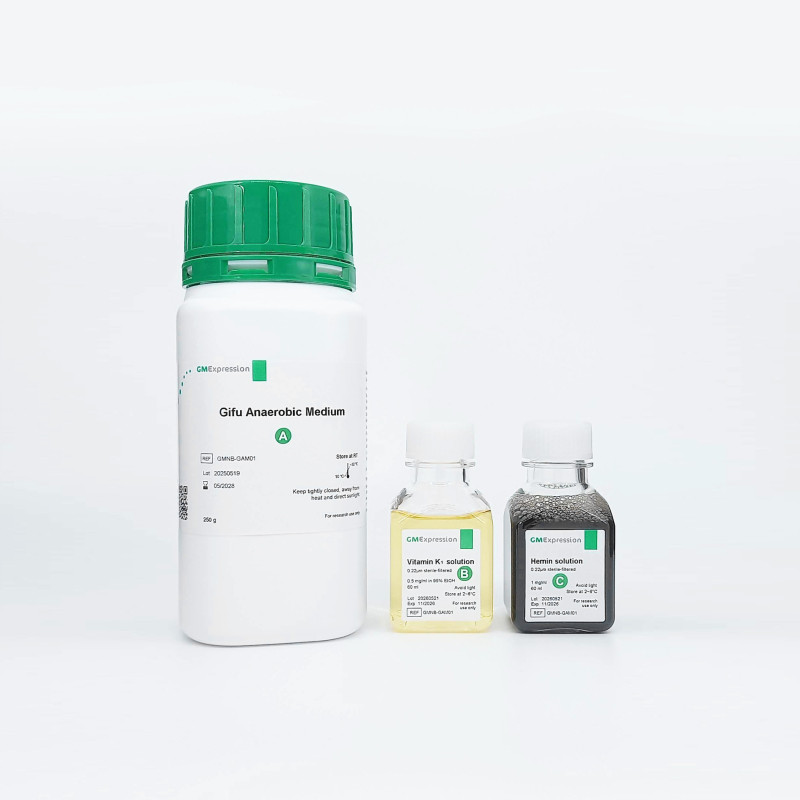
Gifu Anaerobic Medium, GAM | 250g
- Product Code: GMNB-GAM01
- Availability: In Stock
Tags: GAM Medium
Overview
Gifu Anaerobic Medium (GAM) is a rich, non-selective general-purpose broth for the cultivation and isolation of obligate and facultative anaerobic bacteria, developed by Tomotari Mitsuoka and colleagues at the University of Tokyo.
GAM combines a multi-peptone and digested-serum proteinaceous base with a dual L-cysteine + sodium thioglycollate reductant system, which together drive a low oxidation–reduction potential (Eh) and create the reducing conditions strict anaerobes require. The serum and liver components supply haem, growth factors and the peptide diversity that make GAM effective for fastidious clinical and gut anaerobes — including Bacteroides, Prevotella, Fusobacterium, Bifidobacterium, Clostridium and the more demanding streptococci.
This is the original GAM formulation, with glucose at 3.0 g/L — the broader-use, mild-fermentation profile preferred for clinical primary isolation and for Clostridium sporulation work. (For long-incubation maintenance and gut-microbiome culturomics, the lower-glucose Modified GAM, mGAM, at 0.5 g/L glucose is preferred.)
The GMExpression dehydrated base is supplied without hemin or Vitamin K₁ in the powder; both are offered as separate, freshly prepared stocks that are added after autoclaving. This design keeps the dry powder stable during storage and shipping, avoids hemin co-precipitation during autoclaving, and lets users who are working only with facultative organisms omit the supplements when they are not required.
We also have
- Modified GAM (mGAM) — glucose reduced to 0.5 g/L for lower acidogenicity, long-incubation maintenance and fastidious gut-anaerobe / Bifidobacterium work.
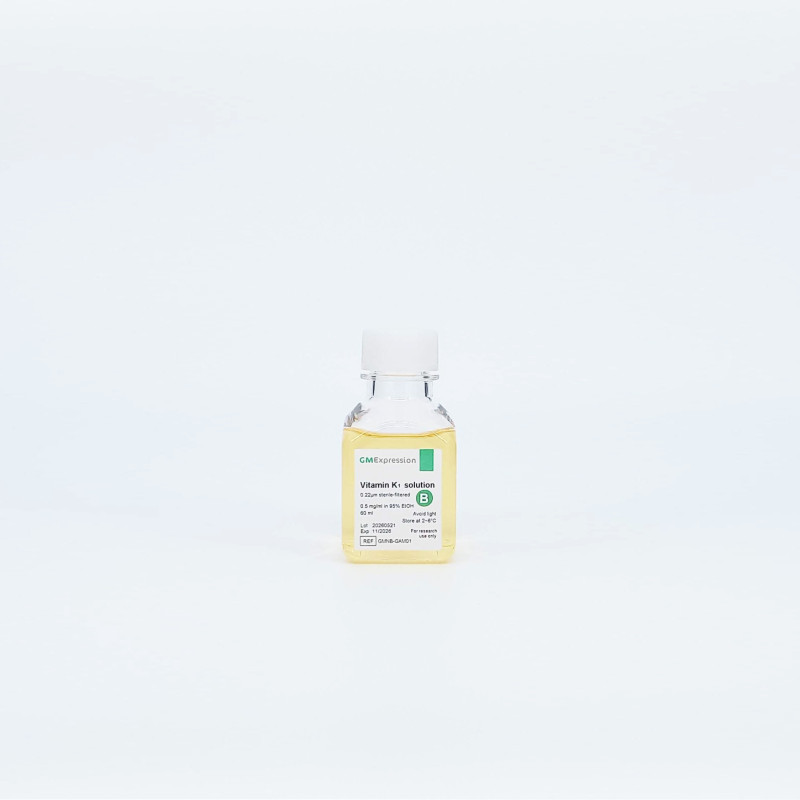
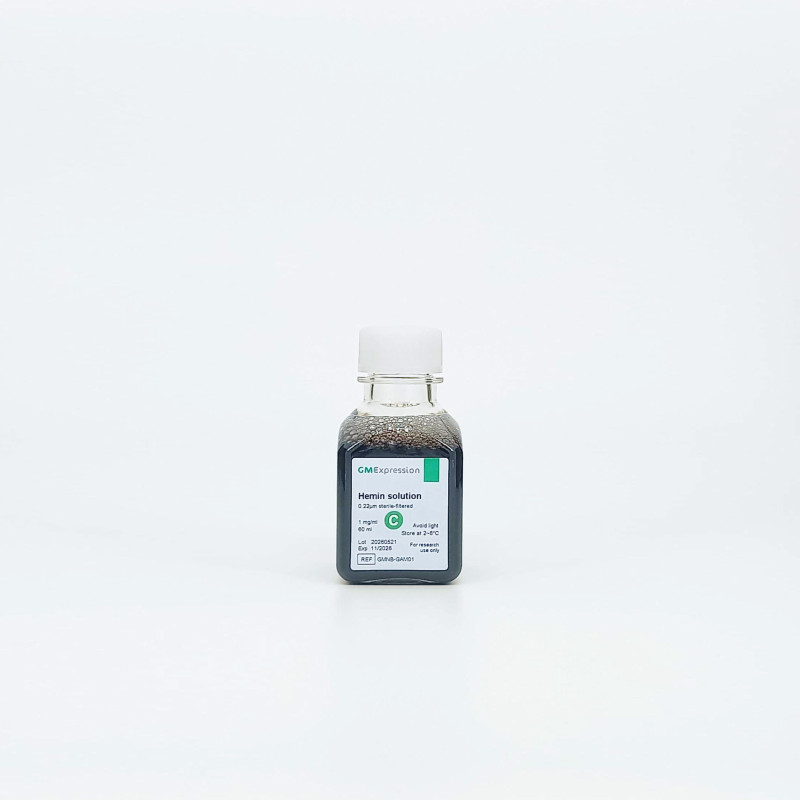
- Vitamin K₁ stock (0.5 mg/mL) and Hemin stock (1 mg/mL) — optional post-autoclave supplements for haem-auxotrophic Bacteroides and other fastidious anaerobes.
- Complementary GMExpression anaerobic media: YCFA Medium (Modified), YCFA Medium (Full), Chopped Meat Broth (ATCC 1490) and PYG Broth.
- Anaerobic Preparation Kit (Lite / Plus) — vacuum-deoxygenation tools for PRAS Hungate-tube workflows.
Package Contents
- Dehydrated GAM base, 250 g — prepares approximately 5 L of medium at 49.0 g/L.
- [Optional, order-based stocks] Vitamin K₁ solution (0.5 mg/mL) and Hemin solution (1 mg/mL), added after autoclaving (10 mL of each per litre).
- [Optional] Anaerobic Preparation Kit (Lite or Plus) for pre-reduced (PRAS) Hungate-tube preparation.
Composition — per 1 L of prepared medium (dehydrated base 49.0 g/L)
Gifu Anaerobic Medium (Dehydrated base per 1L)
| Component | Concentration | Function |
|---|---|---|
| Proteose peptone | 10.0 g | Primary peptide source |
| Soy peptone | 3.0 g | Supplementary peptide; supports Bifidobacterium |
| Yeast extract | 5.0 g | B-vitamins, NAD precursors |
| Beef extract | 2.2 g | Beef-extract complex |
| Digestive serum powder (bovine) | 13.5 g | Serum hydrolysate; haem and growth factors |
| Beef liver powder | 1.2 g | Reducing peptides and growth factors |
| D-Glucose | 3.0 g | Carbohydrate source (original-GAM level) |
| Potassium dihydrogen phosphate (KH₂PO₄) | 2.5 g | Buffer |
| Sodium chloride (NaCl) | 3.0 g | Osmotic balance |
| Soluble starch | 5.0 g | Slow-release carbohydrate |
| L-Cysteine | 0.3 g | Reductant |
| Sodium thioglycolate | 0.3 g | Reductant (dual system with cysteine) |
| Total dehydrated base | 49.0 g |
Anaerobic supplements (post-autoclave additions)
| Component | Final Concentration | Function |
|---|---|---|
| Vitamin K₁ (optional, post-autoclave: 10 mL × 0.5 mg/mL) | 5 mg/L | Supports Bacteroides fumarate-reductase pathway |
| Hemin (optional, post-autoclave: 10 mL × 1 mg/mL) | 10 mg/L | Haem source for haem-auxotrophic anaerobes |
Final pH: 7.3 ± 0.1 at 25 °C.
Use and Applications
GAM is a general-purpose anaerobic broth recommended for the cultivation and isolation of anaerobic bacteria and for susceptibility testing against antibiotics other than sulpha drugs. Because the base contains digested serum (a natural haem source), it also supports fastidious facultative organisms such as streptococci, pneumococci and meningococci, and is suitable for blood-culture applications.
- Primary isolation and cultivation of obligate and facultative anaerobes from clinical, gut-microbiome and food specimens.
- Antimicrobial susceptibility testing of anaerobes (non-sulpha agents).
- Clostridium primary isolation and sporulation — the 3.0 g/L glucose level favours vigorous first-passage growth.
- Semisolid / solid formats — add agar (3 g/L semisolid; 15 g/L solid) for transport-hold tubes or isolation plates.
- Probiotic and food microbiology — Lactobacillus, Bifidobacterium and Clostridium identification.
Compatible Microorganisms
GAM is non-selective and broad-spectrum. Representative validated taxa:
- Obligate anaerobes: Bacteroides fragilis (ATCC 25285), B. vulgatus (ATCC 8482), B. thetaiotaomicron; Prevotella, Porphyromonas; Fusobacterium nucleatum; Bifidobacterium spp.; Eubacterium spp.; Clostridium perfringens (ATCC 13124), C. sporogenes (ATCC 11437), Clostridioides difficile; Veillonella parvula.
- Facultative / fastidious: Streptococcus pyogenes (ATCC 19615), other streptococci, pneumococci and meningococci; Lactobacillus / Lacticaseibacillus spp.; Enterococcus faecalis; Escherichia coli (no selective agent).
Preparation
For semisolid or solid medium: add agar before autoclaving — 3 g/L for a semisolid transport/hold format, 15 g/L for isolation plates (pour at ~50 °C).
Critical control points
- Heat to dissolve. The starch and serum components must be fully dissolved by heating before autoclaving; otherwise a white colloidal precipitate forms on cooling.
- 115 °C autoclave cycle. The lower cycle minimises Maillard browning of the serum + starch + cysteine blend; 121 °C produces visibly darker (still functional) medium.
- Dual reductant system. The cysteine + thioglycollate combination gives a lower Eh than cysteine alone; do not omit either component.
- Post-autoclave supplementation. Add Vitamin K₁ and Hemin stocks only after cooling to ~50 °C, to avoid hemin co-precipitation and Vitamin K₁ degradation during the sterilisation cycle.
Cautions
Storage and Expiry · Safety
Store the dehydrated base tightly closed in a cool, dry place away from light. Optional Vitamin K₁ and Hemin stocks are order-based (2–5 business days to prepare) and should be refrigerated and protected from light. Prepared medium is best held under an anaerobic, vacuum-sealed atmosphere with an oxygen absorber at 4 °C, which extends the functional shelf life to approximately six months. A lot-specific SDS is supplied and available under the Documentation tab.
Customs & Documentation
GAM contains bovine-derived components and is treated as a regulated product under most national biosecurity regimes. GMExpression supplies the documentation pack used across its anaerobic-media exports:
References
- Mitsuoka T, Sega T, Yamamoto S. (1965). Eine verbesserte Methodik der qualitativen und quantitativen Analyse der Darmflora von Menschen und Tieren. Journal of Bacteriology 89: 1556. (Original GAM publication.)
- Mitsuoka T. (1992). Intestinal flora and aging. Nutrition Reviews 50(12): 438–446.
- Nissui Pharmaceutical Co. Ltd. Product information: GAM Broth (05422), Modified GAM Broth (05426).
- Carroll KC, Pfaller MA, et al. (eds). (2019). Manual of Clinical Microbiology, 12th ed. Washington, DC: ASM Press.
- Zheng J, et al. (2020). A taxonomic note on the genus Lactobacillus. Int J Syst Evol Microbiol 70: 2782–2858.
Frequently Asked Questions
Safety Data Sheet:


